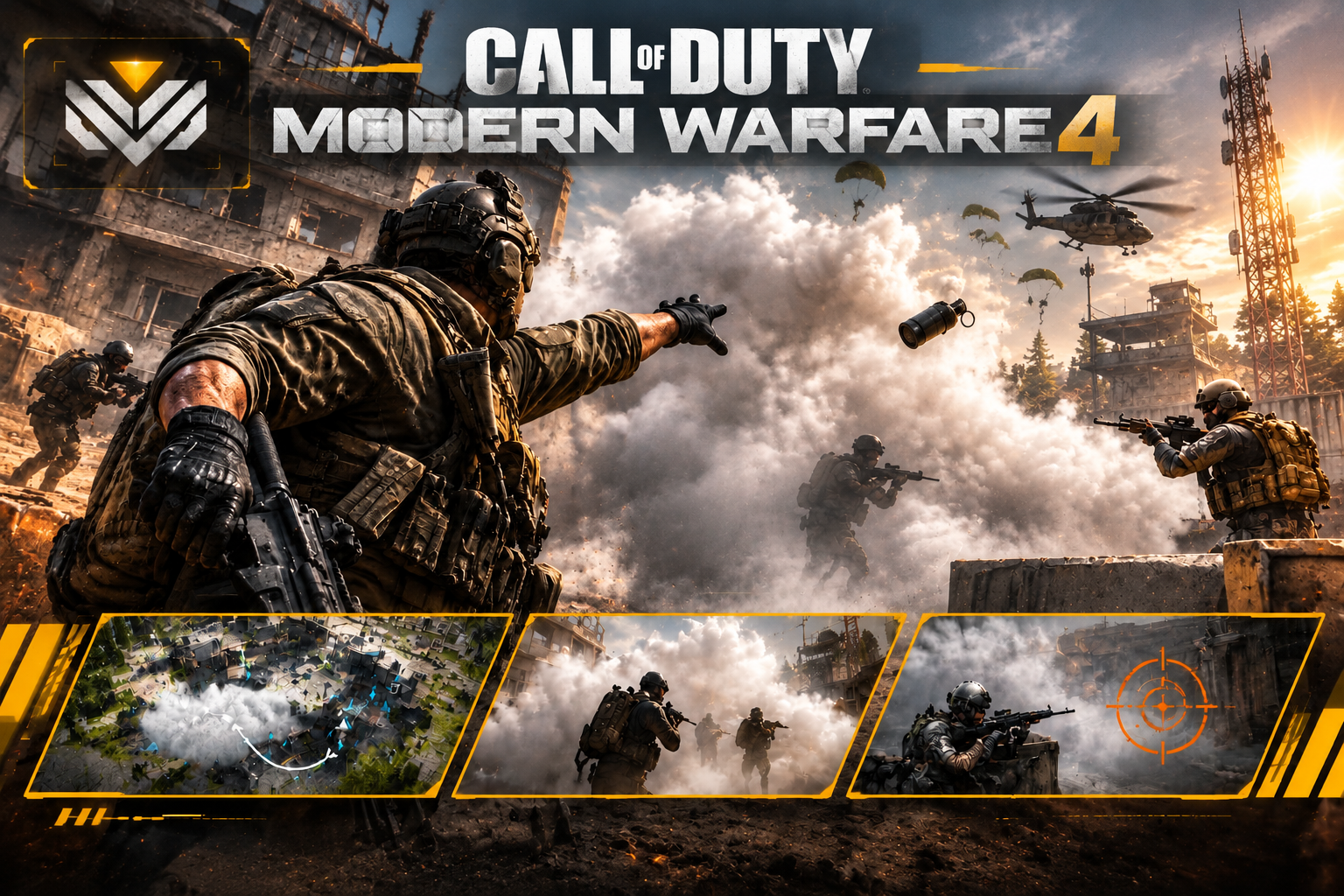
Smoke Grenades have long been a familiar part of Call of Duty multiplayer, but their tactical importance depends on how visibility and targeting mechanics interact with the rest of the combat system. In Modern Warfare 4, this equipment offers more than a temporary hiding place. Its ability to obstruct enemy vision and interfere with automated targeting creates opportunities to reposition, support teammates, and cross exposed areas under pressure. Players exploring different approaches in MW4 Bot Lobbies can also benefit from understanding how smoke affects enemy positioning and engagement decisions. However, the protection is not absolute, as incoming gunfire and explosions can still threaten anyone moving through the covered area.
This creates an interesting balance between concealment and vulnerability. A well-placed Smoke Grenade can interrupt an opponent's established firing angle, delay target acquisition, and give teammates additional time to advance. Yet the same smoke screen does not prevent enemies from attacking based on their knowledge of the map or the direction of incoming movement. Its effectiveness depends on how players use the opening it creates rather than simply how much space the smoke covers.
Smoke Changes More Than What Players Can See
The primary function of a Smoke Grenade is to obstruct visibility. Once deployed in an exposed area, it makes it harder for opponents to maintain a clear view of positions behind the smoke screen. This can be especially useful when crossing open ground, approaching an objective, or leaving a location that has attracted sustained enemy attention. Instead of relying entirely on movement speed or unpredictable positioning, players gain another way to interfere with the information available to opponents.
MW4 adds another tactical consideration through the smoke's ability to block automated targeting systems. This effect gives the equipment a purpose beyond ordinary visual concealment. Opponents may lose a targeting advantage they would otherwise have during an engagement, creating an opportunity for players to change direction or move into a more favorable position. The resulting disruption can be particularly valuable when several enemies are watching the same route and a direct approach would leave an advancing player exposed.
Smoke can also influence the decisions made by both sides. An opponent who loses a clear view of an approaching player may hesitate, adjust their position, or redirect attention toward another angle. Even a brief interruption can affect the timing of an engagement. A teammate can use that moment to move closer to an objective, while another player may take advantage of the reduced visibility to establish a different firing position. This disruption can force defenders to reconsider their immediate priorities and give the attacking team more room to coordinate its next move.
Gunfire and Explosions Limit the Protection Smoke Can Provide
Smoke Grenades are not indestructible defensive barriers. Weapon fire and explosions can penetrate or disrupt their coverage, so players cannot assume that entering a smoke-filled area guarantees safety. This limitation becomes especially important in narrow passages and objective locations, where opponents may already know the most likely routes of approach.
Imagine an enemy controlling a narrow corridor with a clear firing angle. A Smoke Grenade deployed across the passage can interrupt their visibility and make it harder to track an approaching player. However, the opponent may continue firing into the covered area or use explosives to challenge the advance. The smoke creates uncertainty, but it does not remove the danger of crossing the corridor. Players still need to consider nearby cover, alternative routes, and the possibility of sustained attacks from positions they cannot currently see.
The difference becomes clearer across several common combat situations, where smoke can provide a tactical advantage without removing the risks associated with incoming attacks.
| Combat situation | Potential advantage | Important limitation |
|---|---|---|
| Crossing exposed ground | Interrupts enemy sightlines during movement | Incoming fire can still reach the covered area |
| Approaching an objective | Makes it harder for defenders to maintain visual control | Explosions can disrupt the smoke coverage |
| Breaking away from combat | Creates an opportunity to leave an established firing position | Opponents may continue attacking through the smoke |
| Disrupting automated targeting | Interferes with automated target acquisition | Does not prevent ordinary weapon fire |
| Supporting team movement | Gives teammates an opportunity to reposition | Poor placement can obstruct friendly visibility too |
These limitations make positioning particularly important. A smoke screen placed directly across an enemy's line of sight may provide a useful opening, while one deployed without considering surrounding firing angles can leave players exposed from another direction. The location of the smoke matters just as much as its timing.
The Timing of a Smoke Grenade Can Change an Entire Engagement
Throwing a Smoke Grenade whenever an enemy appears nearby is rarely the most effective approach. Its placement should support a specific movement or combat decision, whether that means advancing toward an objective, escaping an unfavorable exchange, or interrupting an opponent who repeatedly controls an important lane.
During an objective push, deploying smoke too early can give defenders time to recognize the incoming attack and prepare for it. Although their view may become restricted, they can still anticipate the likely direction of movement based on the map layout and the current state of the match. A more carefully timed throw can interfere with their vision just as teammates begin advancing, leaving defenders less time to adjust their positions.
Retreating requires similar consideration. A Smoke Grenade can interrupt an opponent's view when a player needs to leave a difficult engagement, but the escape route remains important. Moving directly through a predictable passage may still expose the player to sustained fire. Changing direction, using nearby cover, or moving toward an alternative route can make better use of the smoke screen.
Players examining Modern Warfare 4 Smoke Mechanics should pay attention to three connected factors: the position of the smoke, the movement it is intended to support, and the likely response from opposing players. A deployment that interrupts an important sightline can create a genuine tactical opportunity. One that merely fills an empty section of the map may accomplish very little, particularly when teammates have no clear plan for using the resulting coverage.
Practical Situations Where Smoke Grenades Provide the Most Value
The effectiveness of Smoke Grenades varies with map design, enemy positioning, and the objectives being contested. Their strongest applications usually involve changing an opponent's ability to observe or respond to movement. Several situations offer particularly useful opportunities:
- Crossing dangerous sightlines: Deploying smoke near an exposed crossing can make it harder for opponents positioned along elevated routes or long corridors to maintain a clear view. Players still need to move decisively and avoid predictable paths.
- Supporting objective pressure: During an attack on a contested location, smoke can interfere with defenders watching the main approach. Teammates can use the opening to move closer, establish alternate angles, or prepare for the next stage of the push.
- Creating a retreat opportunity: When an engagement becomes unfavorable, a well-positioned smoke screen can disrupt the opponent's view long enough to support a change of position. Choosing an appropriate escape route remains essential.
- Breaking established firing angles: Opponents who repeatedly control the same lane may lose their visual advantage when smoke covers the area. This can encourage them to reposition and give the attacking team another opportunity to challenge the location.
- Coordinating team movement: Smoke becomes more useful when teammates understand the intended direction of an advance. One player can deploy it while others move toward cover, approach an objective, or establish pressure from another angle.
Placement deserves particular attention in these situations. A grenade thrown into an area that does not affect an opponent's actual line of sight may have little impact, even if it produces a large smoke cloud. By contrast, covering a key intersection or interrupting a defender's view of an important route can influence the entire engagement. Effective use comes from understanding the map and recognizing which enemy positions need to be disrupted.
Smoke Grenades Reward Awareness Rather Than Passive Defense
Modern Warfare 4 gives Smoke Grenades a more interesting place in multiplayer combat by combining visual obstruction with interference against automated targeting. Their limitations prevent them from becoming a universal defensive solution, but those restrictions also make their use more dependent on player judgment. A successful deployment requires an understanding of enemy positions, map geometry, and the movement that should follow.
The equipment is most valuable when it changes the timing or direction of an engagement. A smoke screen can help an attacking team approach a contested location, interrupt a defender's control of a firing lane, or give a player enough time to leave an unfavorable position. These advantages do not last indefinitely, so players need to act before opponents adapt. Team coordination and awareness remain just as important as the initial equipment choice.
Discussions around CoD MW4 Boosting often focus on progression and unlocks, but understanding equipment interactions also contributes to better multiplayer performance. Smoke Grenades demonstrate how a familiar tactical item can influence positioning, target acquisition, and team movement without guaranteeing protection from incoming attacks. Rather than serving as an automatic escape tool, they reward players who recognize the right moment to disrupt an engagement and turn an opening into a meaningful advantage.